
Sustainability Vision
"To Lead with Purpose Towards a Sustainable Future"
Sustainability Mission
- Implementing best practices in greenhouse gas (GHG) and energy management.
- Maintaining low levels of environmental pollution across all our operations.
- Achieving zero incidents related to occupational health and safety (OHS).
- Sustaining long-term value for our stakeholders.
- Supporting the professional and personal development of our human resources.
- Managing and implementing corporate social responsibility (CSR) programs to support local community development.
Guided by this vision and mission, PT Alamtri Resources Indonesia Tbk ("AlamTri" or "the Company") formulates and implements a sustainability strategy that integrates economic, environmental, social, and governance (ESG) considerations into corporate planning, decision-making processes, and business development initiatives.
The implementation of our sustainability roadmap has begun over the past few years. Key milestones include the identification of material topics, the development of an ESG strategy framework, the establishment of a Sustainability Management Team, the calculation of GHG emissions, the issuance and implementation of a net zero emissions (NZE) roadmap, and the periodic update of material sustainability topics.
AlamTri’s ESG Strategy Framework
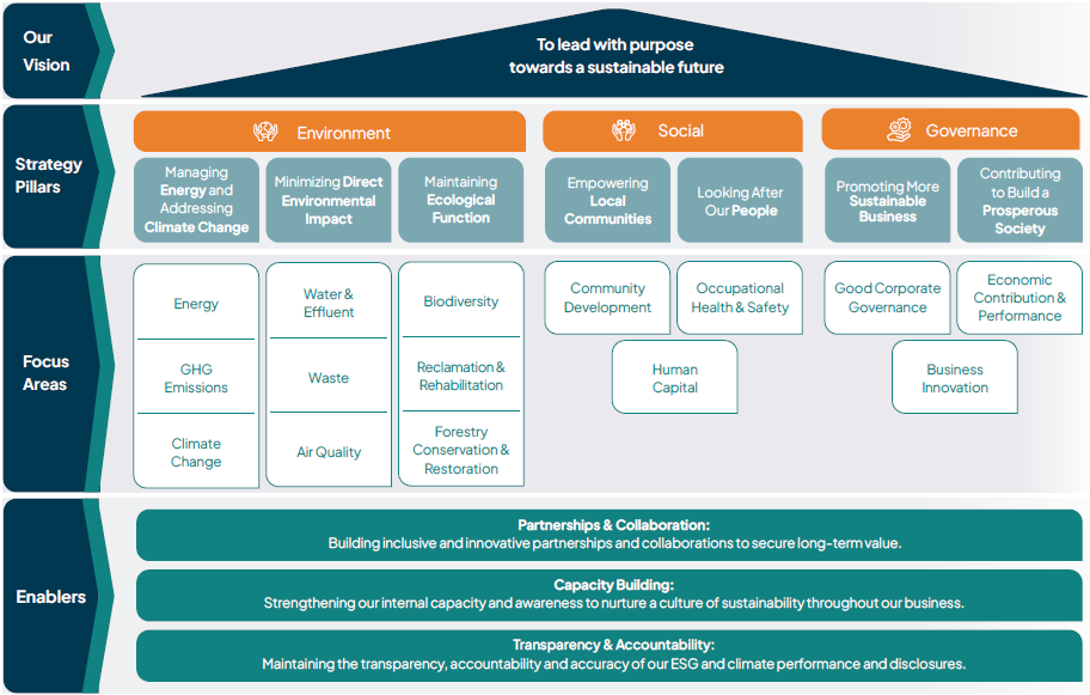
AlamTri’s ESG Strategy Framework was formulated to identify, address and manage AlamTri’s ESG risks through ESG three components: environment, social, and governance. The focuses and priorities for these three components are based on the materiality and relevance to the business. The ESG Strategy Framework also includes "enablers", or the measures set as the bases of the AlamTri’s ESG roadmap, programs, and initiatives. In line with the current global trend, among AlamTri’s priorities, the main focus is GHG emissions and energy performance management.
In addition, AlamTri instills the values of Integrity, Meritocracy, Openness, Respect, and Excellence across its workforce as guiding principles in daily operations and in supporting sustainable business practices. To ensure the consistent application of these values, the Company has established a Code of Conduct that serves as a behavioral guideline for all AlamTri employees. For more information, please visit the Code of Conduct page on the Company's website.
NZE Commitment
AlamTri fully supports the government’s commitment to reduce GHG emissions, including efforts to achieve NZE by 2060 or earlier through various initiatives. AlamTri has calculated the GHG emissions generated from its operational activities (scope 1 and scope 2) and continues to implement a range of measures for the reduction and/or sequestration of GHG emissions.
AlamTri is committed to developing businesses in sectors that support Indonesia’s downstreaming business ecosystem towards more sustainable economy. Strategic initiatives that have been initiated include market development for metallurgical coal, an essential material for steel production and aluminium smelter operations, alongside the continued expansion of renewable energy businesses. This commitment aligns with the Company’s sustainability strategy and represents its support for the Government of the Republic of Indonesia’s decarbonization agenda.
In line with AlamTri’s commitment, a series of decarbonization strategies has been formulated and translated into several key initiatives, including:
- Preparing calculation of GHG emissions generated from operational activities for Scope 1 and Scope 2.
- Utilizing lower-carbon fuels and renewable energy sources.
- Implementing operational excellence programs.
- Assessing the adoption of low-carbon technologies and carbon offset implementation.
- Preparing to participate in Indonesia’s Carbon Economic Value chain.
- Developing low-carbon business lines.
AlamTri aims to diversify its business portfolio over the medium to long term as part of its commitment to the green economy and sustainable development. This strategy is also intended to strengthen the Company's resilience and relevance amid evolving climate policies, technological advancements, and dynamic global market conditions.
As part of this strategy, AlamTri is expanding its renewable energy business through PT Alamtri Renewables Indonesia under the AlamTri Eco pillar. At the same time, through PT Alamtri Minerals Indonesia Tbk and its subsidiaries, the company focuses on metallurgical coal mining and mineral processing through an aluminum smelter. These commodities play an important role in supporting sustainable industrial transformation, particularly as part of the industrial value chain that underpins infrastructure development, manufacturing, and the advancement to low-carbon technologies.
NZE Roadmap
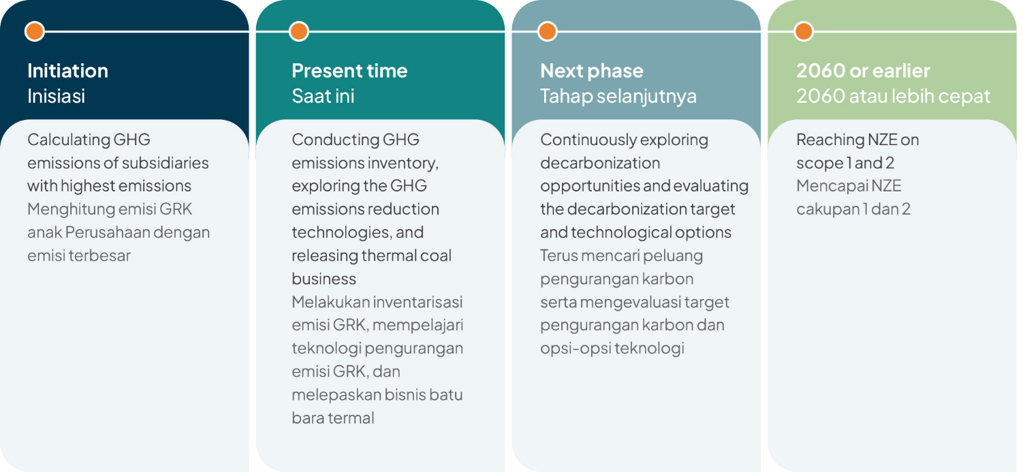
AlamTri has demonstrated its commitment to sustainability by launching a NZE Roadmap aligned with the targets set by the government. The roadmap outlines the strategic steps AlamTri will take to achieve its goal of creating a sustainable future for all stakeholders. AlamTri has also developed a roadmap that provides clear and measurable guidance on the steps needed to achieve its targets within a specific timeframe. One of the key points in AlamTri’s NZE Roadmap is its commitment to achieving NZE by 2060 or earlier, in line with the government’s commitment outlined in the Second Nationally Determined Contribution (SNDC). Achieving this target will require extraordinary efforts from all parties within AlamTri.
The Implementation of AlamTri’s NZE Roadmap Consists of Three Phases:
- Preparation Phase (2022-2030) enhancing GHG emissions management, operational excellence, and the use of renewable energy.
- Transition Phase (2030-2040) utilizing carbon reduction technologies that are both technically and commercially viable.
- Responsible Carbon Phase (2040-2060 or earlier) exploring carbon removal opportunities to address unavoidable emissions.
AlamTri’s Mitigation Efforts
- Initiated the use of biodiesel (B5) in operational activities in 2013 (currently using B40).
- Reduced fossil fuel consumption and increased the use of renewable energy through electrification, co-firing, and the development of solar PV for operational activities and infrastructure facilities.
- Implemented carbon sequestration projects, watershed rehabilitation, and revegetation to support government environmental programs, including the development of energy plantations.
- Carried out programs focused on operational excellence and energy management.
AlamTri has begun assessing the feasibility of using renewable energy to reduce biodiesel consumption, as well as exploring available technology options to ensure the effectiveness of its decarbonization efforts, such as low-carbon fuel technologies and low-emission operational fleets. Furthermore, there will be continual monitoring and adoption of advancements in decarbonization technologies as part of its commitment to achieving NZE.
Material Topics
AlamTri treviewed its material topics in 2025 following changes to its corporate structure that became effective in December 2024. The review was conducted to ensure that the identified material topics remain relevant and continue to reflect the Company's most significant economic, environmental, and social impacts, as well as the sustainability-related matters that are most relevant to stakeholders and the Company's long-term value creation. Based on the review, the Company identified 11 material topics that serve as the primary focus of its sustainability strategy, management approach, and sustainability reporting. Further information on the material topics can be found on Sustainability Report page 100.
AlamTri’s Contribution to the Sustainable Development Goals
AlamTri develops and implements comprehensive sustainability programs as part of its contribution to achieving the Sustainable Development Goals. As of the reporting year, AlamTri has implemented various sustainability programs, as detailed on Sustainability Report page 70.